Revenue That Moves at the Speed of Your Market.
When pipeline shifts, quota assumptions break, or market conditions change, revenue plans built in disconnected tools fall apart. Fintastic gives revenue leaders a unified environment where pipeline, capacity, and financial plans stay connected, so every forecast reflects what's actually happening in the business.
Legacy revenue planning tools were designed for simpler sales organizations. Fintastic was built differently, with an architecture that handles the scale, dimensionality, and speed that modern revenue operations demand. Your models stay fast, your scenarios stay current, and your team stays focused on hitting numbers, not maintaining spreadsheets.

.png)
.png)
.png)
.png)
.png)
.png)
.png)


.png)
.png)
.png)
How Fintastic Handles Planning and Analysis Complexity
Fintastic was built for enterprise planning environments where models grow large, data updates continuously, and teams must evaluate multiple scenarios quickly.


How Fintastic Handles Planning and Analysis Complexity
Enterprise planning environments require models that scale, data that stays current, and scenarios that run without limits.
Where Systems Struggle
How Fintastic Handles It
Slow Calculations
As datasets expand, recalculations slow down planning workflows and delay decisions.
Adaptive Modeling
Models evolve alongside operational complexity without structural redesign.
Fragmented Models
Teams split models across files or modules to maintain performance.
Independent Scenario Versioning
Multiple scenarios run simultaneously without slowing down any other version.
Limited Scenario Testing
Running multiple scenarios degrades model performance, so teams are forced to limit the number of versions they maintain.
High-Performance Computation
Calculations remain fast and can accommodate an order-of-magnitude larger dimensionality than industry benchmarks.
Planning Becomes Coordination
Finance teams spend more time maintaining their platforms and communicating outside the platform than analyzing outcomes.
Continuous Data Synchronization
Operational data stays aligned with planning models through incremental updates.
How Fintastic Handles Planning and Analysis Complexity
Enterprise planning environments require models that scale, data that stays current, and scenarios that run without limits.
Where Systems Struggle
How Fintastic Handles It
Slow Calculations
As datasets expand, recalculations slow down planning workflows and delay decisions.
Adaptive Modeling
Models evolve alongside operational complexity without structural redesign.
Fragmented Models
Teams split models across files or modules to maintain performance.
Independent Scenario Versioning
Multiple scenarios run simultaneously without slowing down any other version.
Limited Scenario Testing
Running multiple scenarios degrades model performance, forcing teams to limit the versions they maintain.
High-Performance Computation
Calculations remain fast and accommodate an order-of-magnitude larger dimensionality than industry benchmarks.
Planning Becomes Coordination
Finance teams spend more time maintaining platforms and communicating outside the system than analyzing outcomes.
Continuous Data Synchronization
Operational data stays aligned with planning models through incremental updates.
How Fintastic Handles Revenue Planning Complexity
Revenue planning environments require models that connect pipeline, capacity, and financial outcomes without fragmentation or manual reconciliation.
Where Tools Break Down
How Fintastic Is Built Differently
⏱

The Challenge
Disconnected Revenue Models
Pipeline, quota, capacity, and compensation plans live in separate tools and spreadsheets, with no shared logic.
⚡

Fintastic Solution
Adaptive Modeling
Revenue models evolve as sales structures, product lines, and go-to-market strategies change without requiring structural rebuilds.
📂

The Challenge
Slow Scenario Testing
Modeling a new territory structure or pricing change means rebuilding models, not just adjusting assumptions.
🔄

Fintastic Solution
Independent Scenario Versioning
Pipeline scenarios, pricing models, and coverage plans run simultaneously and independently, so testing one doesn't overwrite or slow down another.
⚠️

The Challenge
Stale CRM Data
Forecasts rely on manually exported pipeline snapshots rather than live operational data, creating a lag between what's happening and what's planned.
🚀

Fintastic Solution
High-Performance Computation
Large, multi-dimensional revenue datasets across reps, territories, products, and time horizons are calculated in seconds, not hours.
🔧

The Challenge
Revenue and Finance Misalignment
Sales teams and finance teams run on different numbers, creating reconciliation cycles that slow decisions instead of enabling them.
🔗

Fintastic Solution
Continuous Data Synchronization
CRM, ERP, and HRIS data stay aligned with planning models through live updates, so forecasts can always reflect current actuals.
Core Planning and Analysis Capabilities
Fintastic is built on a unified planning architecture that handles complex enterprise models at scale, without sacrificing calculation speed or fragmenting workflows across models. With Fintastic, finance teams can:
- Run complex calculations across millions of data points without model slowdown
- Maintain a unified planning model instead of fragmented workflows
- Support concurrent users without locking or delays
- Connect forecasts directly to operational drivers and actuals
- Use native AI to analyze plans, actuals, and scenarios through natural language questions while surfacing insights across planning models
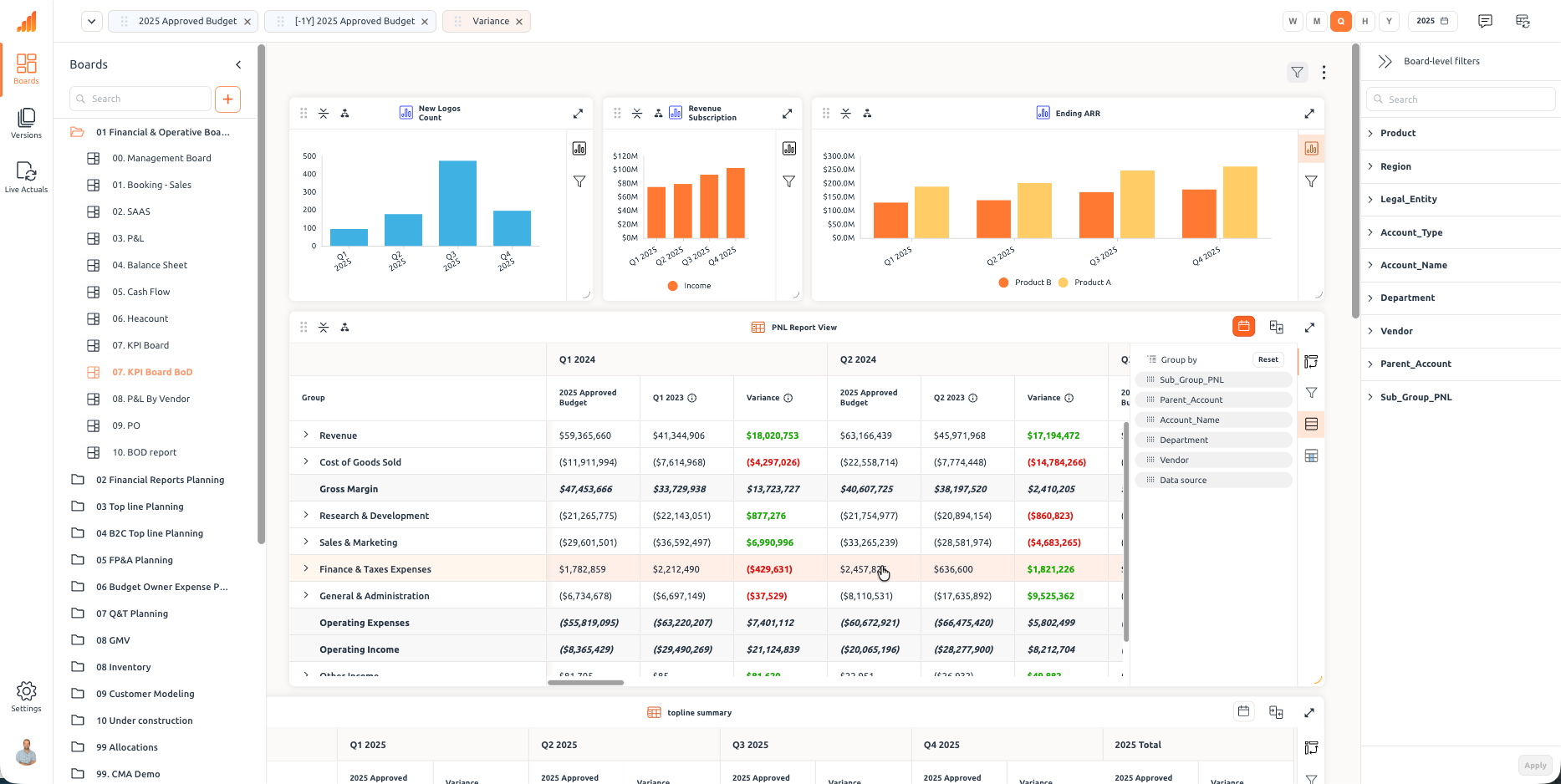
One Unified Platform for Revenue Planning and Analysis
Built on an architecture that connects pipeline, capacity, and financial plans at scale, with no model fragmentation, no stale data, and no version conflicts.
Scale Without Limits
Multi-dimensional revenue datasets across reps, territories, products, and time horizons calculated in seconds, not hours.
Connected to Your Business
Pipeline, CRM, and financial data linked in one unified planning model so forecasts always reflect current reality.
AI-Native Analysis
Ask questions in natural language about pipeline health, scenario outcomes, or forecast variance across all revenue models.
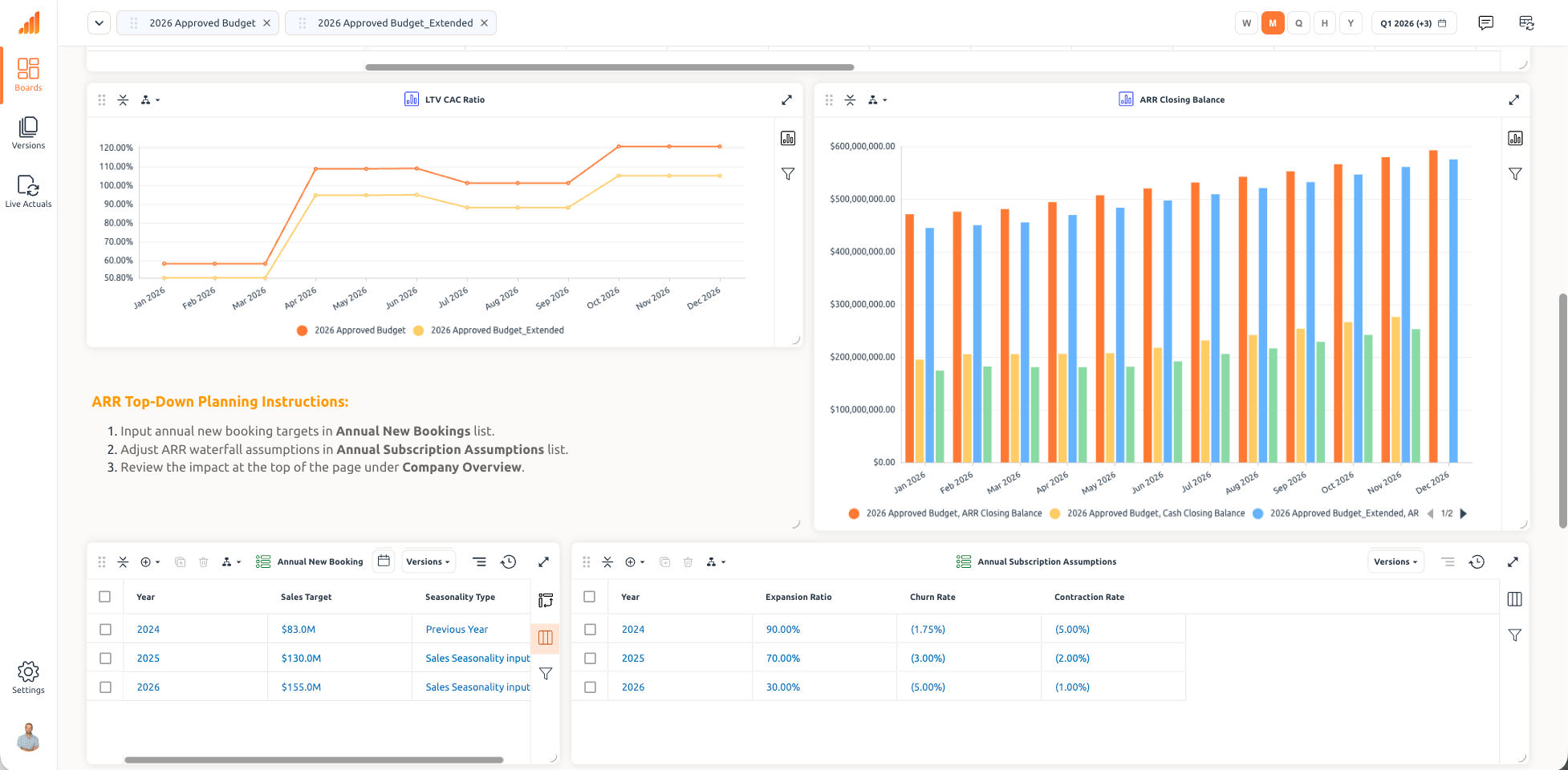
Revenue Use Cases
.png)

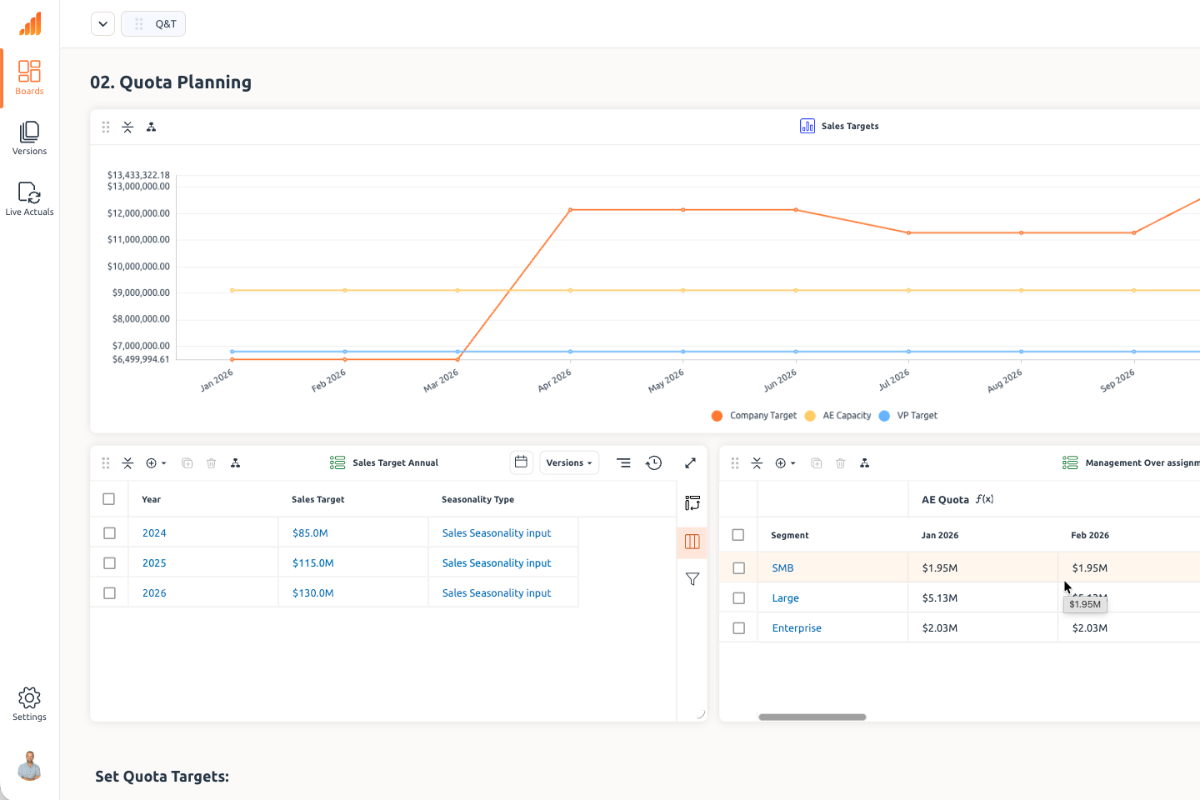
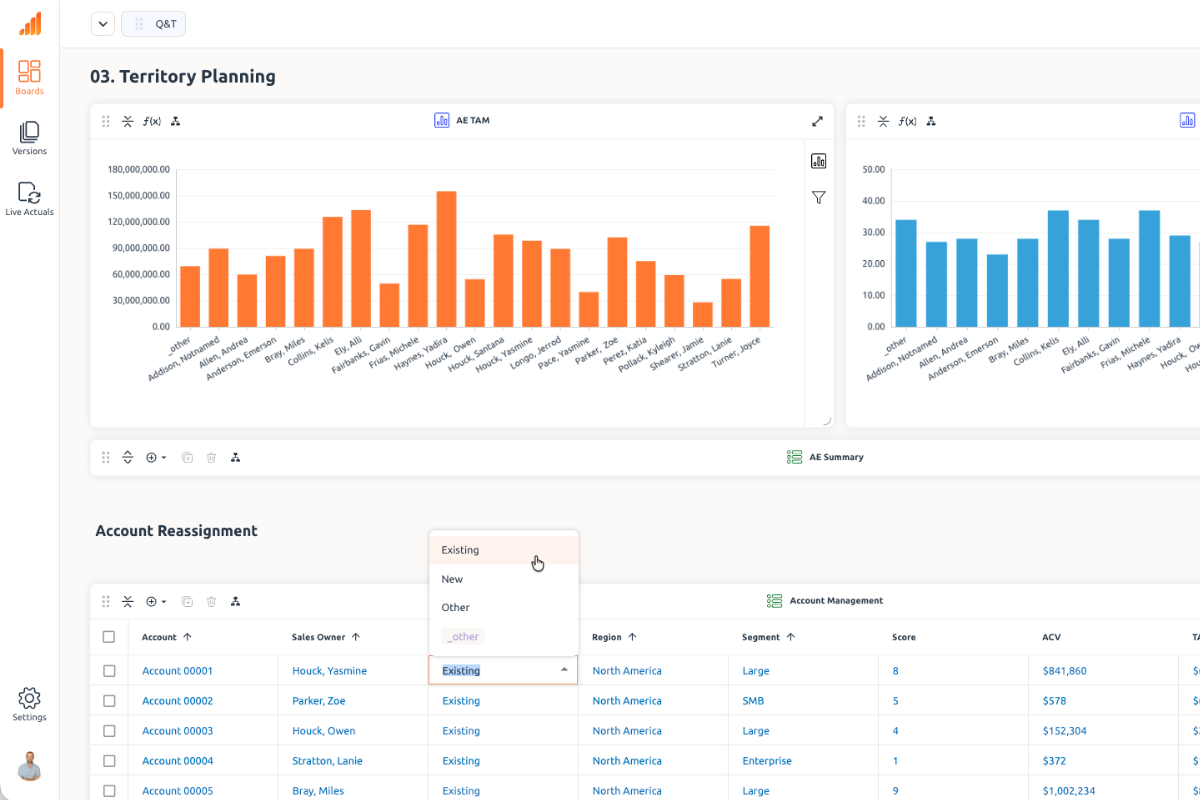
Territory, Quota & Capacity Planning
Design and optimize territory coverage, quota allocation, and sales headcount capacity in a unified model that reflects organizational reality and adjusts as it changes.
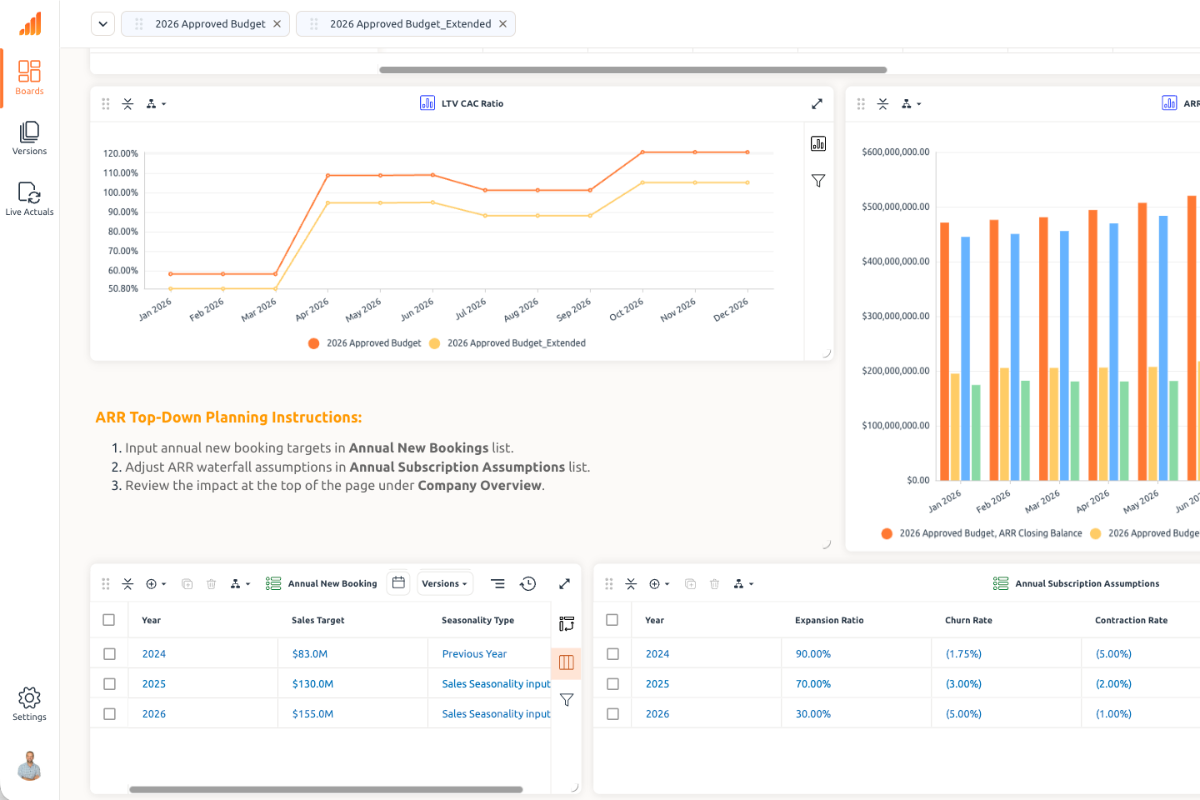
Revenue Scenario Modeling
Model the revenue impact of coverage gaps, market shifts, pricing changes, or churn acceleration, all simultaneously, without overwriting your base plan.
Compensation & Incentive Planning
imulate the cost and behavior implications of OTE structures, accelerators, and SPIFFs before committing to a comp plan for the year.
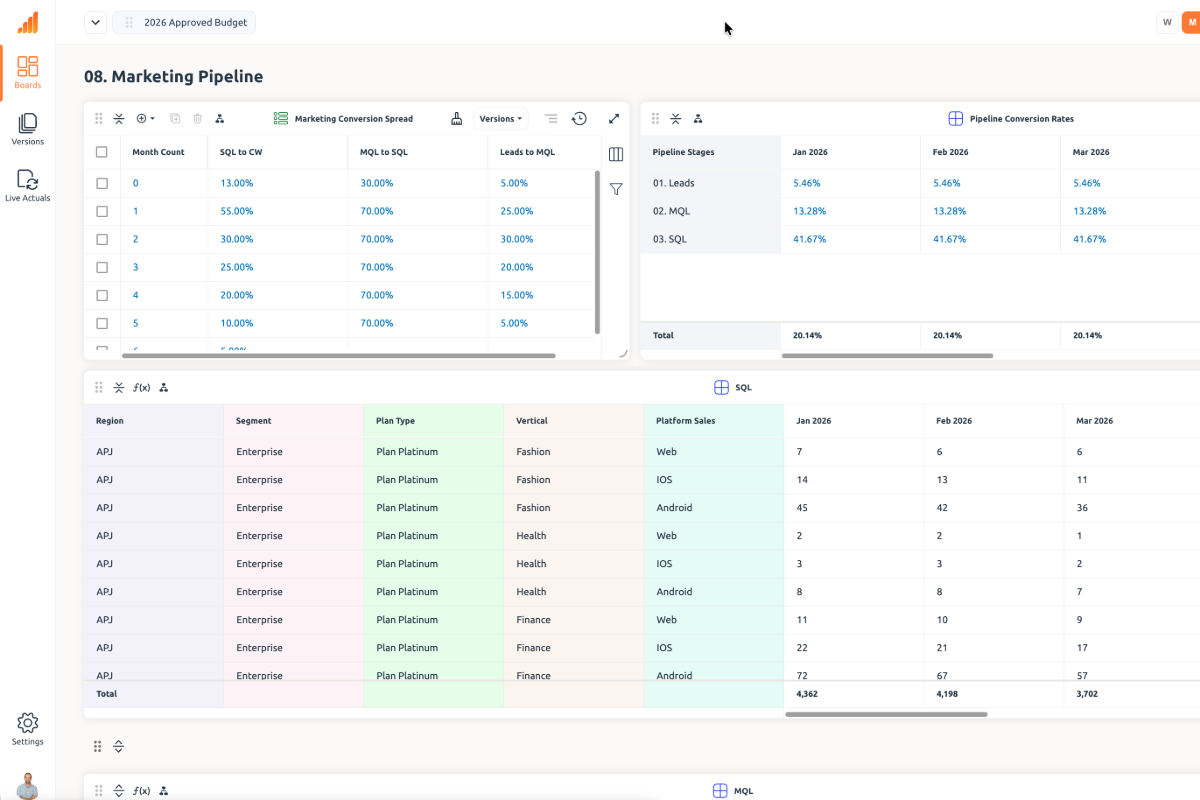
Marketing-to-Pipeline ROI Modeling
Connect marketing spend assumptions directly to pipeline-generation models, so revenue and marketing teams share a single view of their business within a single model.
Business Outcomes
Revenue organizations using Fintastic report faster forecasting cycles, tighter alignment between sales and finance, and greater confidence in the numbers they present to leadership.

Faster Forecasting Cycles
Shorter cycles with less manual reconciliation.

Revenue and Finance Alignment
Sales and finance teams work from the same model with no reconciliation overhead and no version confusion.

Responsive Scenario Planning
Revenue leaders can test multiple coverage, pricing, or headcount scenarios in real time.

Revenue as a Strategic Partner
Revenue teams positioned as a planning function, not just a reporting function.
Proven Results from Planning Teams
.png)
In my finance career, it's rare to see an interconnected platform of this scale support iterative scenario planning without sacrificing speed or reliability. Fintastic has been a meaningful addition for Priceline.
.png)
Before implementing Fintastic, business stakeholders couldn't easily create or maintain scenarios. Now there are multiple scenarios that are easily managed and compared, allowing us to plan ahead and make more data-driven decisions.
.png)
Artlist reduced time spent on their BVA (budget vs. actual) reporting cycle by 70% - with analysis available at PO-level granularity, always live, with no manual consolidation required.
.png)
Fintastic has been a game changer for our FP&A team! What used to take us days can now be done in mere minutes.


What Happens When Your Planning Platform Finally Keeps Up.
In my finance career, it’s rare to see an interconnected platform of this scale support iterative scenario planning without sacrificing speed or reliability. Fintastic has been a meaningful addition for Priceline.
Before implementing Fintastic, business stakeholders couldn't easily create or maintain scenarios. Now there are multiple scenarios that are easily managed and compared, allowing us to plan ahead and make more data-driven decisions.
Artlist reduced time spent on their BVA (budget vs. actual) reporting cycle by 70% - with analysis available at PO-level granularity, always live, with no manual consolidation required.
Fintastic has been a game changer for our FP&A team! What used to take us days can now be done in mere minutes.
Frequently Asked Questions
Revenue planning and analysis platform enables organizations to forecast bookings, model territory and quota structures, evaluate pipeline scenarios, and align revenue projections with financial plans. It connects operational data from CRM and other systems to planning models so teams can work from a single, continuously updated source of truth.
As sales organizations grow, revenue planning requires coordinating across more territories, product lines, segments, and go-to-market motions.
Disconnected tools make it difficult to keep forecasts, quota, capacity, and financial targets in sync. Model complexity grows faster than the platform's ability to support it, leading to fragmentation and slow cycles.
Fintastic was built from the ground up for enterprise complexity. Revenue models stay fast as they grow, without fragmentation or performance trade-offs. Revenue leaders can model territories, quotas, and pipeline scenarios in a single Fintastic model, all connected to financial plans and live operational data, something that isn't possible on legacy platforms.
Yes. Fintastic supports concurrent users across revenue, finance, marketing, and operations teams within the same planning environment. Multiple stakeholders can interact with the same model without locking, performance delays, or version conflicts. Access controls and granular permissioning ensure each team sees what they need and nothing more.
Revenue teams use Fintastic for territory and quota planning, pipeline and bookings forecasting, compensation and incentive modeling, coverage and productivity analysis, churn and expansion revenue modeling, and marketing-to-pipeline ROI planning.
Fintastic includes native AI capabilities built directly into the planning architecture, not bolted on top. Revenue teams can ask questions in natural language about pipeline health, scenario outcomes, or forecast variance, while AI retrieves answers from the models themselves.
Revenue Planning That Keeps Pace with Your Business
Fintastic enables revenue teams to plan at enterprise scale, test scenarios instantly, and stay aligned with finance as the business evolves.
