How a Scaling Cybersecurity Company Cut Close Time by 50%


.png)

When your business scales faster than your planning tools, the finance team ends up spending more time managing spreadsheets than managing the business. Here’s how one cybersecurity company broke out of that cycle.
Claroty is a rapidly growing cybersecurity company providing mission-critical cyber-physical systems with visibility and protection. As the company scaled, their Excel-based budgeting and forecasting process became unsustainable.
The finance team faced increasing model complexity, manual and inflexible data management, cumbersome scenario analysis, and time-consuming coordination during close. On top of NetSuite (the company’s cloud ERP where financial transactions and accounting data are managed), the month-end close process required complex coordination across teams, manual version management, and lengthy consolidation and approval cycles.
The business had outgrown its tools.
When Scenario Planning Becomes Critical
As Claroty’s business complexity increased, comparing and analyzing scenarios became central to strategic planning. In Excel, this process was cumbersome and often impossible.
The team needed the ability to create and maintain multiple scenarios simultaneously, compare versions instantly, model different assumptions and logic structures, and update forecasts quickly using current actuals.
The limitation wasn’t analytical capability. It was the platform.
This is a common inflection point for scaling companies. The FP&A team has the skills and the business context to run sophisticated analysis. But the tools they’re working in can’t keep up with the volume of questions leadership needs answered.
Shifting to Scenario-Based Planning at Scale
After implementing Fintastic, Claroty was able to create an unprecedented number of scenarios and compare them at the click of a button.
The platform enabled unlimited scenarios with varying assumptions, different logic structures within models, automated forecast updates, and unified actual and forecast data views.
Forecast updates shifted from manual and error-prone to automated and controlled. Claroty’s end-of-quarter headcount plan is now fully updated one month after the quarter begins, rather than two-thirds of the way through the quarter.
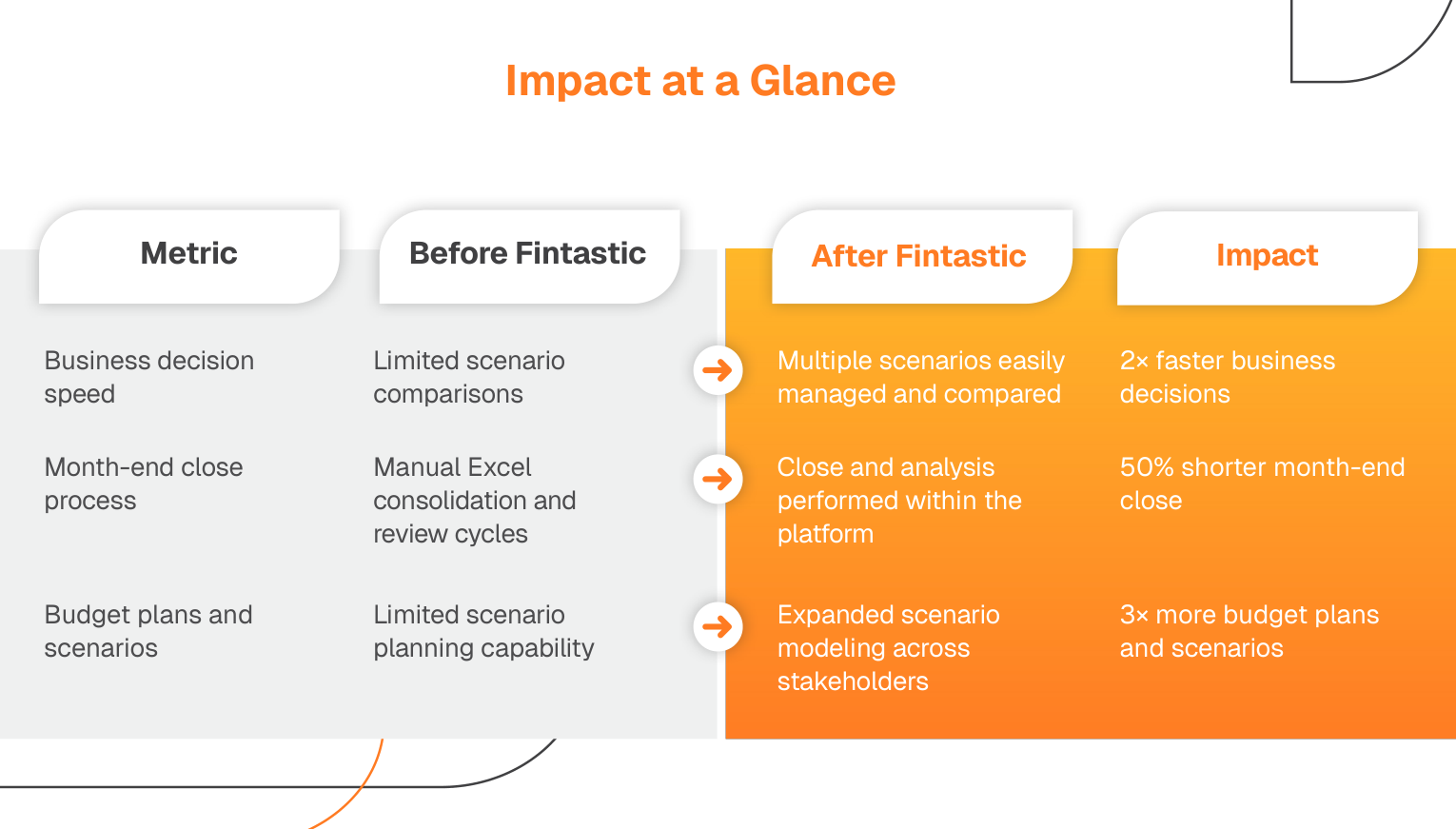
The impact on scenario capacity was dramatic: a 3x increase in the number of budget plans and scenarios the team can maintain simultaneously.
2x Faster Business Decisions
With a unified actual data view seamlessly stitched to forecast models, stakeholders can view financial and operational results earlier and make faster decisions.
Emmanuel Blum, Director of FP&A at Claroty, described the shift: Before implementing Fintastic, business stakeholders couldn’t easily create or maintain scenarios. Now, at a given time, there are multiple scenarios that are easily managed and compared, allowing us to plan ahead and make more data-driven decisions.
This is the part that matters most for the business. Faster scenario analysis doesn’t just save the finance team time. It gives leadership better information sooner, which changes the quality of decisions across the company.
50% Shorter Month-End Close
Before Fintastic, the accounting team manually consolidated data into Excel and circulated spreadsheets for review and analysis. The month-end close was a coordination exercise that consumed the finance team for days.
After implementation, data automatically feeds into the platform. Review and analysis occur within the system. Teams collaborate directly on live data. Multiple versions and periods can be compared easily. Drill-down to journal entry level is available.
The result: a 50% reduction in time and effort required for the month-end close process.
Ron Kariv, Senior Financial Controller at Claroty, described the change: We completely eliminated the effort and time-consuming meetings and work involved in the end-of-month close. Team members across different regions now collaborate through a single source of truth, running analysis and making reports much faster and easier.
Building the Annual Plan and Beyond
After modernizing planning and close, Claroty built its annual plan on the platform. Tens of stakeholders now collaborate within a consistent data environment, modeling scenarios, updating plans as actual data becomes available, and driving informed decisions.
Beyond planning, the platform now supports budgeting, forecasting, reporting, and broader financial and operational processes, creating a single source of truth for the finance team.
The Pattern for Scaling Companies
Claroty’s experience follows a pattern that many scaling companies recognize. The FP&A team starts with spreadsheets. They work well at first. As the business grows, complexity increases and the spreadsheet-based processes start breaking: longer close cycles, limited scenario analysis, manual data consolidation, and stakeholders who can’t self-serve.
The inflection point isn’t about company size. It’s about decision complexity. When the number of scenarios, stakeholders, and data sources exceeds what manual processes can handle reliably, the architecture underneath planning needs to change.
If your finance team is spending more time coordinating close than analyzing results, or if scenario planning is limited by the tools rather than the team’s analytical capability, the constraint is structural.
Download the FP&A Leader’s Roadmap →
