Financial Planning that Scales with Complexity
Finance teams are expected to guide strategy continuously, but many planning systems struggle as models expand and more stakeholders collaborate.
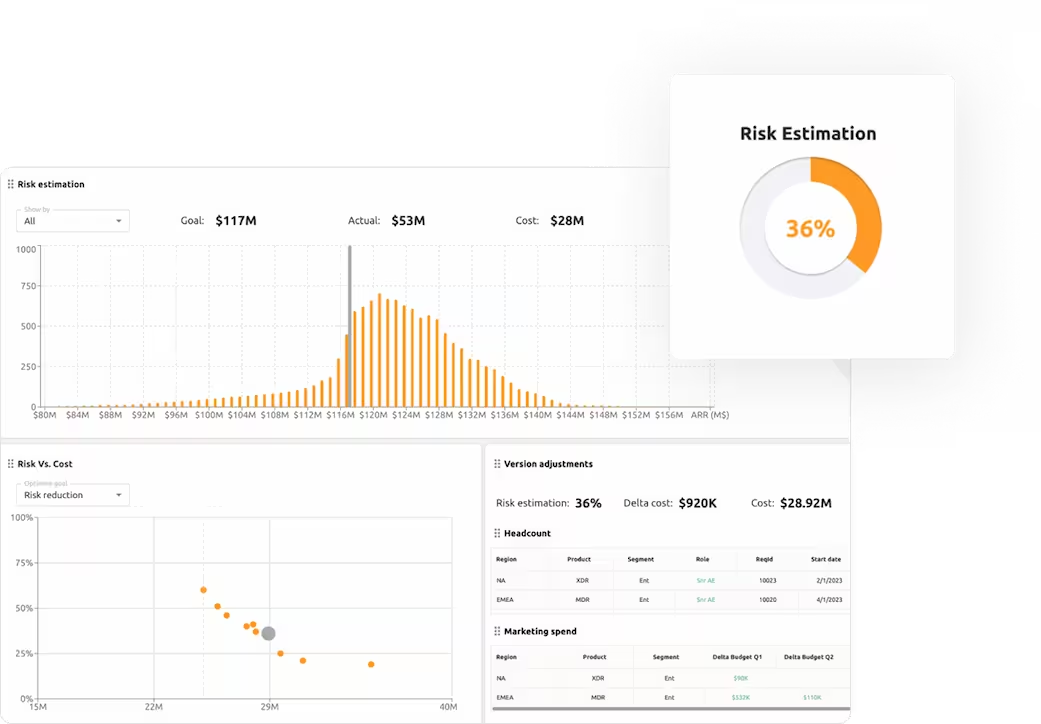
Fintastic provides a unified planning architecture that allows complex financial models, scenarios, and forecasts to remain aligned as organizations scale.

.png)
.png)
.png)
.png)


.png)
.png)
.png)
Why do financial planning systems struggle as organizations scale?
As financial models expand across products, regions, entities, and time horizons, many planning systems begin to slow down or fragment. Finance teams often end up splitting models, waiting for calculations, or coordinating forecasts across disconnected workflows. Common challenges include:

Calculations slow down as datasets grow and model complexity increases

Planning workflows split across multiple models or files to maintain performance
Scenario analysis becomes harder to run and repeat frequently
Forecast cycles require coordination across teams instead of exploration
When calculations take minutes and models must be fragmented to keep working, finance stops leading and starts waiting.
Core Planning Capabilities
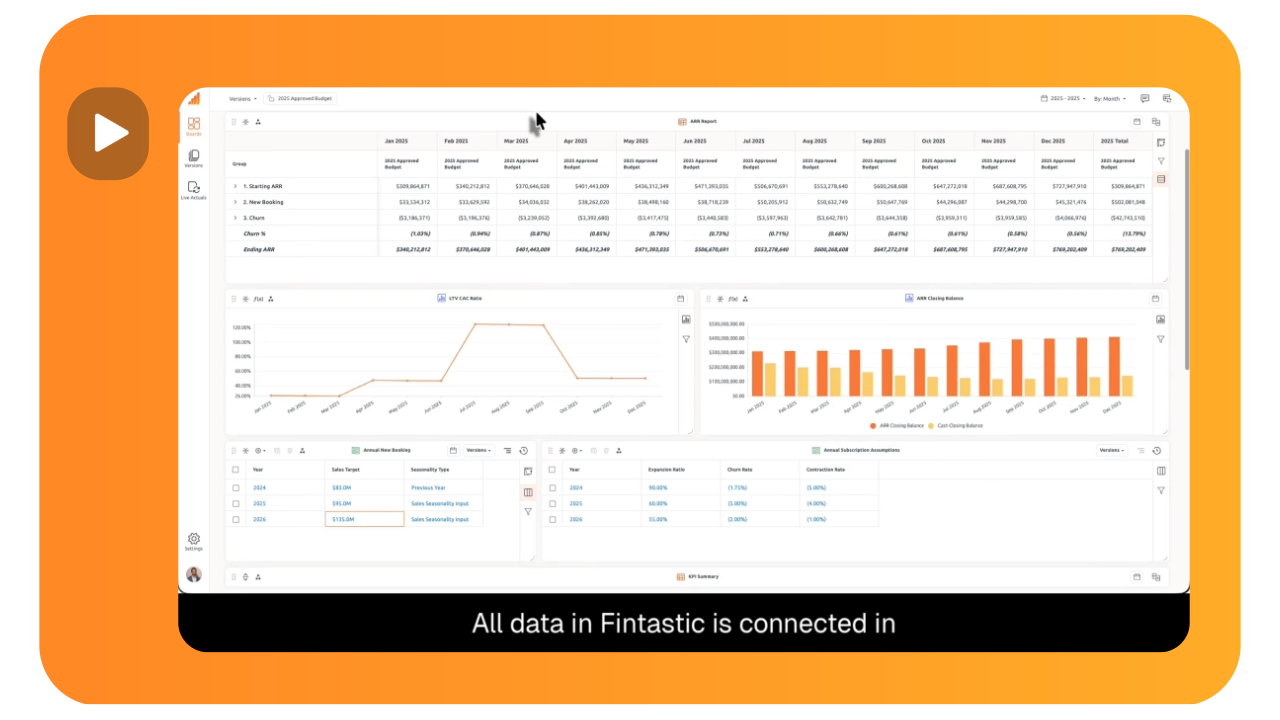
Fintastic enables finance teams to operate from a unified planning architecture designed to support complex financial models as organizations scale without slowing calculations or fragmenting planning workflows.
With Fintastic, finance teams can:
- Run full-model calculations quickly, even at enterprise scale
- Maintain a unified planning model instead of fragmented workflows
- Keep forecasts aligned with live actual data
- Support concurrent users without locking or delays
- Use native AI to analyze plans, actuals, and scenarios through natural language questions while surfacing insights across planning models
Finance Use Cases
.png)
Corporate & Business-Unit Planning
Build corporate and business-unit financial plans while maintaining alignment across departments.
Long-Range Planning & Scenario Testing
Evaluate long-term strategy by modeling scenarios and testing financial assumptions over time.
Margin, Cost & Cash-Flow Modeling
Analyze margins, operational costs, and cash flow at detailed levels across the business.
Variance Analysis
Identify performance changes by connecting financial variance directly to operational and revenue drivers.
Trusted by Finance Planning Teams
Organizations using Fintastic have achieved measurable operational and financial outcomes.

Reduced scenario calculation time from minutes to seconds and reduced actuals import from about one hour to under five minutes, enabling faster forecasting cycles and broader collaboration.
Read the full StoryPriceline

Reduced budget versus actual effort by 70%, increasing planning granularity while freeing finance teams from manual coordination.
Read the full StoryArtlist

Accelerated decision-making by 2x and shortened month-end close by 50%, allowing finance teams to respond faster to changing conditions.
Read the full StoryClaroty
Business Outcomes
Faster and more defensible decision-making
Shorter planning cycles with less manual effort
Higher confidence forecasts

Finance positioned as a strategic operator instead of a reporting function
Take your creative workflow to the next level
Enterprise finance teams need to run scenarios quickly, keep forecasts aligned with live data, and support collaboration without rebuilding models.
Fintastic provides a unified planning foundation where complex planning models remain fast, aligned, and collaborative. Finance teams can evaluate scenarios continuously and guide the business with confidence as conditions change.
Frequently asked questions
Enterprise financial planning software enables finance teams to build forecasts, run scenarios, and model financial outcomes across products, regions, entities, and time horizons.
Unlike spreadsheets or fragmented planning tools, modern platforms allow organizations to maintain connected financial models and evaluate strategy as conditions change.
As companies grow, financial models become more complex. Planning systems often struggle to maintain performance when datasets expand and more users collaborate.
To keep models functioning, teams frequently split planning workflows across multiple files or environments, which makes scenario analysis slower and forecasting cycles harder to manage.
Fintastic provides a connected planning environment designed to support enterprise-scale financial models without sacrificing performance.
Finance teams can run full-model calculations quickly, maintain a single connected planning model, and keep forecasts aligned with live actual data.
Yes. Fintastic supports concurrent users so finance, operations, and business teams can collaborate within the same planning environment without locking or performance delays.
This allows organizations to maintain alignment across plans while supporting cross-functional planning workflows.
Fintastic supports a range of financial planning workflows including:
* Scenario modeling
* Forecasting and reforecasting
* Enterprise-scale financial modeling
* Collaborative planning across teams
These capabilities help finance teams evaluate strategy and maintain aligned forecasts as the business evolves.
