The Great Replatforming in Enterprise Planning


.png)
How the Innovator’s Dilemma Is Reshaping the Category
A Breaking Point for Enterprise Planning
After three decades helping build and scale enterprise software companies, from early-stage startups to category-defining global platforms, I’ve learned there’s a moment in every industry where the old architecture simply can’t keep up with the new demands being placed on it.
Enterprise planning has reached that moment.
Finance teams aren’t just dealing with budgets anymore. They’re navigating constant disruption: geopolitical shifts, supply chain volatility, consumer sentiment that can change so fast it will give you whiplash, and boardroom pressure to make decisions in days, not quarters. And yet the systems many organizations still depend on were built 15, 20, even 30 years ago. They were never designed for today’s speed, dimensionality, and scale.
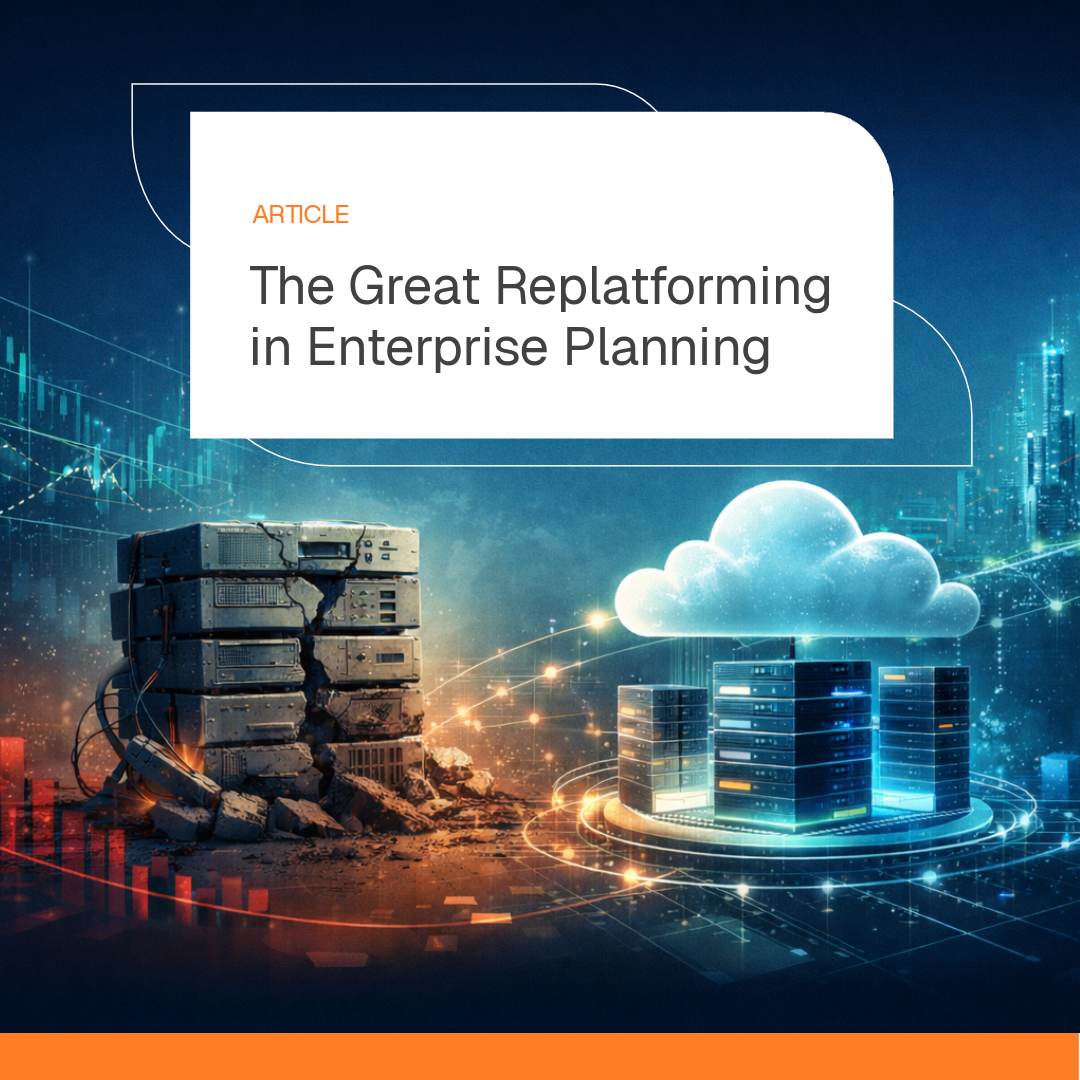
This mismatch is why we’re experiencing what I call the Great Replatforming: a generational shift away from legacy planning systems toward AI-native, cloud-scale platforms built for continuous decisioning. And the root cause of this shift is something I’ve watched play out my entire career: the Innovator’s Dilemma.
When Your Market-Leading Tech Becomes Your Liability
One thing you learn quickly working in enterprise software is that success as a trailblazer often becomes the very thing that slows you down.
Legacy planning systems were revolutionary when they first emerged. They offered the first real alternative to spreadsheets for large-scale modeling. But the foundations they were built on, legacy SQL architectures, monolithic engines, and brittle back-end components, have not aged well. And no amount of patching will fix structural limitations.
I remember sitting in a security review with a major tech company as we went through page after page (13 pages, to be exact) of required changes to a certain planning platform’s backend. Every item on the list was valid. Every fix was expensive. To make matters worse, more than several lines of code were built on technology that wasn’t even supported anymore.
That’s technical debt in a nutshell.
When planners tell you their model takes an hour to run, or they’re stepping out for “toaster time” while their screen spins, you know you’ve hit the limits of what that architecture can do. In large enterprises where planning can involve thousands of dimensions, billions of data points, and endless scenario permutations, these limitations aren’t annoyances; they’re blockers.
The Innovator’s Dilemma: Unplanned Obsolescence
I’ve watched multiple companies face the exact same crossroads: Rebuild the platform or continue retrofitting the old one.
Rebuilding is expensive, slow, disruptive, and scary. Retrofitting feels easier. It feels safer and less costly. But it always leads to stagnation, and in the long run, that’s the death knell for any business, especially one whose purpose is to plan for the future.
Years ago, I sat in leadership meetings at a planning company evaluating whether to launch a full rebuild of the core engine. The product team proposed a next-generation architecture – something completely new, AI-capable, and built for the future. But ultimately, that initiative was abandoned in favor of “fixing the old thing.”
That’s the Innovator’s Dilemma in its purest form: short-term safety at the expense of long-term survival and innovation. And once a company makes that decision, it’s almost impossible to recover. Retrofitting is a treadmill – each fix leads to another. Every patch creates more debt. Meanwhile, the market moves on while you’re stuck in place just trying to keep up.
I’ve seen this story play out across multiple generations of enterprise software, from ERPs to procurement to planning. The pattern repeats. The companies that rebuild early win. The companies that wait fall behind.
Modern Planning Requires Modern Tools
The consequences of this technical stagnation eventually show up where it matters most: with customers. In large enterprises, I’ve seen planning teams become dependent on highly specialized “model builders” just to keep systems running. I’ve seen organizations spend millions on consulting services simply to maintain their models, when they could have been investing in other areas of growth. And I’ve seen countless frustrated teams walk away from legacy platforms after years of performance issues, broken workflows, and multi-hour compute cycles, taking their talents to greener (more innovative) pastures
Today’s buyers are far more sophisticated. They’ve seen better technology in other parts of their stack; they know what’s possible, and they’re increasingly willing to put their badge on the line to adopt a modern platform, especially when the performance gap is undeniable.
Here’s the truth: it’s extremely hard to build an enterprise-grade planning engine from scratch. Many new entrants in the market are effectively spreadsheet enhancers. They’re great for SMBs or mid-market companies, but fall apart when the data piles up or the dimensionality gets complex, as is often the case with large enterprises.
In my view, only two platforms today – Fintastic and Pigment – meet the bar for truly modern enterprise planning in the wor, with:
- AI-native workflows
- Cloud-scale calculation engines
- The ability to handle both dense and sparse multidimensionality
- Fast implementations
- Real-time recalculation without blocking or spinning
Some platforms are taking a genuinely new approach, building not one but multiple calculation engines, designed specifically for large volumes of data and complex models. That architectural choice alone is the difference between waiting hours for a model to run and getting instantaneous answers. It’s the difference between “come back after lunch” and “here’s your answer before your coffee cools.”
This is what the Great Replatforming looks like in practice: platforms built for the next 20 years, not the last 20. Finance organizations can’t afford to run critical planning processes on outdated technology, especially in a world where a single event can invalidate an entire annual plan overnight.
Modern planning isn’t about budgeting cycles anymore. It’s about:
- Continuous scenario modeling
- AI-driven insights
- Real-time signals
- Data readiness from platforms like Snowflake and Databricks
- The ability to ask the system questions in plain language, just like you would an analyst
These aren’t “nice to haves.” They’re requirements, and legacy systems simply weren’t built to operate this way.
Go Deeper: Enterprise Planning Architecture
If you want a technical breakdown of what separates legacy engines from modern, AI-native planning platforms, explore our Enterprise Planning Architecture overview.
→ Read the Architecture Overview
Early Adopters Will Break the Dam
Every major shift in enterprise software hinges on a small group of leaders willing to take a chance on a better way. I’ve seen this dozens of times: when SAP first came to the U.S., when Ariba invented B2B commerce, when cloud planning emerged, and now again with AI-native planning platforms.
Buyers don’t switch because a new tool is slightly better. They switch because they know the old approach cannot take them where they need to go. Once a few lighthouse customers adopt a next-generation platform and show rapid time-to-value, the market moves fast. I’ve watched entire industries pivot almost overnight once the early movers prove what’s possible.
We’re at that point now.
Category Winner or Cautionary Tale?
There’s one lesson I’ve seen proven again and again in my career: You cannot bolt the future onto the past. You have to rebuild for the next wave of innovation.
Every company I’ve worked with that made the bold decision to rebuild, early, decisively, strategically, became a category winner. Every company that waited became a cautionary tale.
We’re in the middle of a Great Replatforming in enterprise planning. The winners will be the platforms built for AI, built for scale, built for collaboration, and built for speed. The ones willing to rethink the entire architecture – not just add features on top of old, rickety foundations – will unlock the greatest opportunity for their customers.
About the Author
Paul Melchiorre is a veteran enterprise software executive and sales leader with more than 25 years of experience pioneering cloud software strategies at the enterprise level. He is the co-author of Selling the Cloud, where he shares the frameworks and methods that helped shape modern enterprise cloud sales.
